Asia Pacific E-bike Market Analysis Report 2034

Global Asia Pacific E-bike Market Growth, Size, Trends Analysis- By Tire, By Class, By Battery, By Motor, By Propulsion, By Ownership, By Power Output, By Sales Channel, By Application – Regional Outlook, Competitive Strategies and Segment Forecast to 2034

Published: Jan-2026 Report ID: AMIN2603 Pages: 1 - 131 Formats*:     
Category : Automotive & Transportation
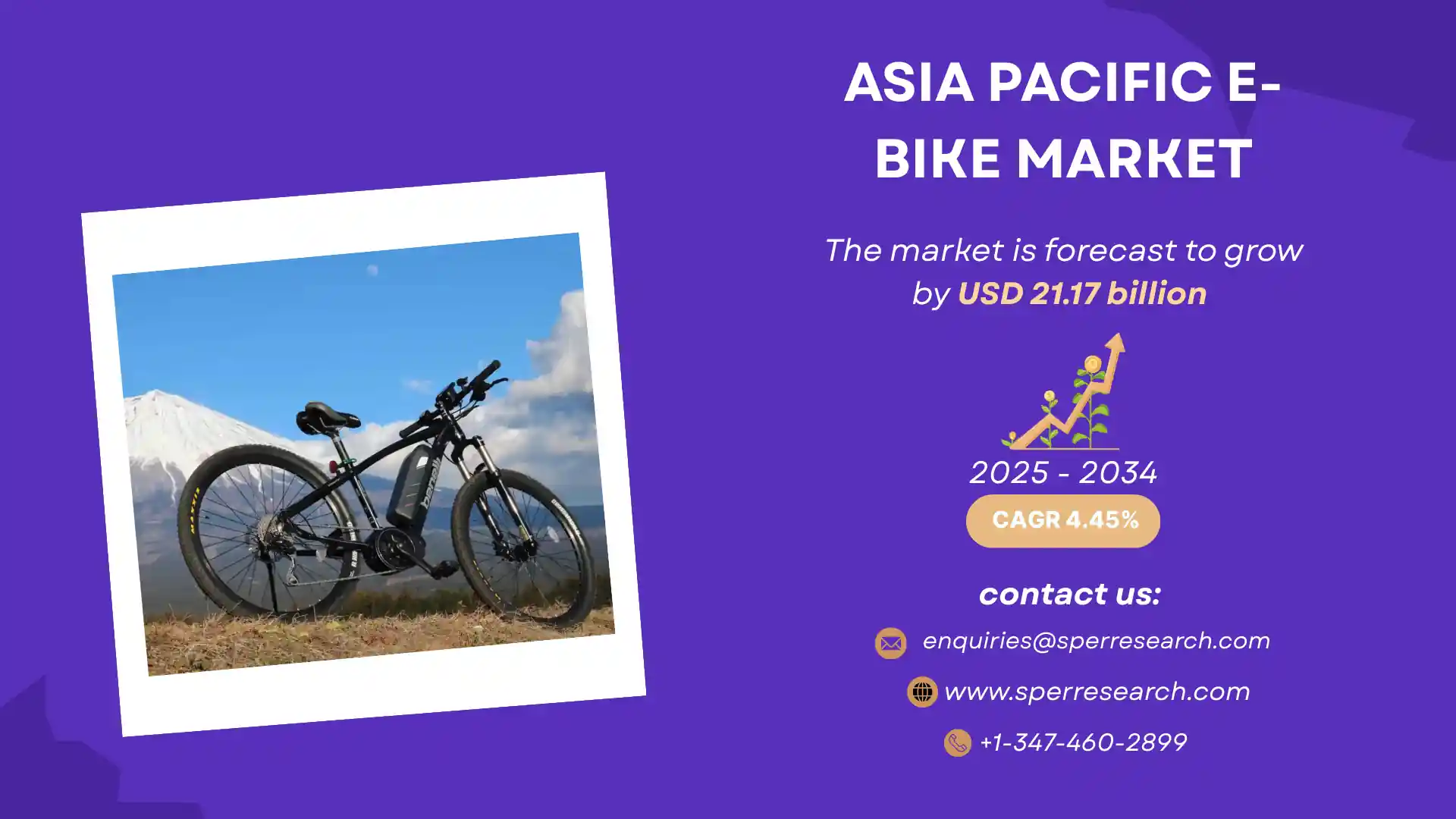
According to SPER Market Research, the Global Asia Pacific E-bike Market is estimated to reach USD 21.17 billion by 2034 with a CAGR 4.45%.

Introduction and Overview

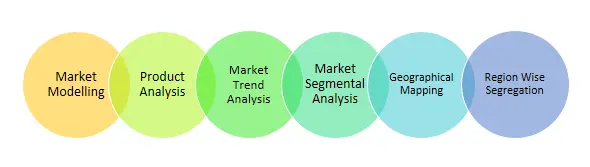
The report includes an in-depth analysis of the Global Asia Pacific E-bike Market, including market size and trends, product mix, Applications, and supplier analysis.

The Asia Pacific E-bike Market was valued at USD 21.17 billion in 2024 and is expected to grow steadily at a CAGR of around 4,45% from 2025 to 2034. The market is witnessing strong growth due to rapid urbanization, increasing traffic congestion, and rising demand for cost-effective and eco-friendly transportation solutions. E-bikes support reduced carbon emissions, lower commuting costs, and improved mobility in densely populated cities. Technological advancements such as improved battery performance and smart connectivity are enhancing adoption. In addition, government initiatives promoting electric mobility, along with rising fuel prices, are accelerating demand for e-bikes across major Asia Pacific economies.

By Class:
By class, Class 1 e-bikes account for the largest share in the Asia Pacific market, as they operate on pedal-assist mode without throttle control and comply with regulations across most countries. These e-bikes are widely used for urban commuting and recreational riding due to their controlled speed, safety, and legal acceptance on public roads and cycling paths. Class 2 e-bikes, which include throttle control, are adopted in select markets but face regulatory limitations. Class 3 e-bikes cater to high-speed performance users; however, stricter rules and safety concerns limit their wider adoption in the region.

By Battery:
Lithium-ion batteries hold the largest share in the Asia Pacific e-bike market due to their lightweight structure, high energy density, and longer lifecycle. These batteries support faster charging and extended riding range, making them suitable for daily commuting and commercial usage. Continuous improvements in battery technology and declining costs have further increased their preference among manufacturers and consumers. Lead-acid batteries remain present in cost-sensitive markets because of their lower upfront price, but their heavier weight and shorter lifespan reduce appeal. Other battery types contribute minimally, mainly in niche or experimental applications.

By Motor:
Hub motors represent the larger share in the Asia Pacific e-bike market, driven by their simple design, lower cost, and ease of maintenance. These motors are commonly used in city and entry-level e-bikes, offering sufficient power for flat urban terrains. Hub motors also support quieter operation and easier installation, making them attractive for mass-market models. Mid motors are gaining traction in premium and performance-oriented e-bikes, as they provide better weight distribution, improved torque, and enhanced efficiency on slopes. However, higher costs limit their widespread adoption compared to hub motors.

By Propulsion:
Pedal-assist propulsion accounts for the highest share in the Asia Pacific e-bike market, as it aligns well with regional regulations and promotes safer riding behaviour. Pedal-assist systems provide motor support only when the rider pedals, improving efficiency while maintaining control. This propulsion type is widely preferred for commuting and recreational use. Throttle-controlled e-bikes are adopted in limited markets where regulations allow motor-only operation. However, concerns related to safety, speed control, and regulatory compliance restrict broader acceptance, keeping pedal-assist systems as the most widely used propulsion type across the region.

By Ownership:
Personal ownership represents the largest share of the Asia Pacific e-bike market, supported by growing commuting needs, lifestyle adoption, and demand for cost-effective transportation. Consumers increasingly prefer owning e-bikes for daily travel, fitness, and leisure activities due to convenience and long-term cost savings. Rising urban populations and traffic congestion further support personal ownership trends. Shared ownership models, including rental and bike-sharing services, are expanding steadily in major cities and tourist areas. However, infrastructure limitations, operational costs, and maintenance challenges currently restrict shared ownership from matching the scale of personal e-bike usage.

By Power Output:
E-bikes with 250W to 750W power output account for the largest share in the Asia Pacific market, as they offer an optimal balance between performance, efficiency, and regulatory compliance. This power range supports smooth acceleration and reliable performance for urban commuting and moderate terrains. Models below 250W are commonly used in densely regulated markets but provide limited power for longer distances. E-bikes above 750W cater to cargo and off-road applications; however, stricter regulations and higher costs limit their widespread adoption compared to mid-range power output models.

By Sales Channel:
Offline sales channels hold the largest share in the Asia Pacific e-bike market, as consumers prefer physical stores for test rides, product comparison, and after-sales support. Dealerships and specialty bicycle stores offer installation, servicing, and warranty assistance, which enhances buyer confidence. Offline channels also support financing options and personalized guidance. Online sales are growing steadily, driven by e-commerce expansion, competitive pricing, and convenience. However, concerns related to assembly, maintenance, and limited physical inspection continue to restrict online channels from surpassing traditional offline retail in most regional markets.

By Application:
City and urban applications account for the largest share of the Asia Pacific e-bike market, driven by increasing daily commuting needs and severe traffic congestion. Urban e-bikes are widely used for short-distance travel, last-mile connectivity, and reducing dependence on fuel-powered vehicles. Trekking e-bikes support recreational and long-distance riding, while cargo e-bikes are gaining traction for logistics and delivery services. Mountain and off-road e-bikes cater to adventure and sports enthusiasts but remain niche. Other applications, including leisure and tourism-based usage, contribute steadily but represent a smaller portion of overall demand.

Regional Insights:
The Asia Pacific e-bike market shows diverse growth patterns across major economies and emerging nations. China accounts for the largest share, supported by strong domestic manufacturing, widespread adoption, and supportive electric mobility policies. Japan and South Korea demonstrate steady demand driven by technological innovation, urban commuting needs, and aging populations. India is witnessing rapid expansion due to rising urbanization, fuel cost concerns, and government support for electric vehicles. Australia shows moderate growth, supported by recreational and urban usage. Southeast Asia, including Indonesia, Thailand, Vietnam, Malaysia, Singapore, and the Philippines, is emerging as a high-potential region, driven by dense urban populations, traffic congestion, and increasing demand for affordable and sustainable transportation solutions.

Market Competitive Landscape:
The Asia Pacific E-bike Market is highly consolidated. Some of the market key players AIMA Technology Group, Giant Manufacturing, Lima Vehicle, Merida Industry, NIU Technologies, Panasonic Corporation, Sunra Electric Vehicle, TAILG Group, Yadea Group Holdings, Yamaha Motor

Recent Developments:
  • In April 2025, Giant partnered with Siemens to present performance e-bikes and performance road bikes of the coming generation. The cooperation seeks to integrate the digital twin and simulation technology of Siemens with the coming- position bike engineering from Giant with a focus on instituting design, perfecting performance and rider experience for the Asia Pacific request.
  • In July 2024, ZELIO E-bikes introduced a new high- speed electric scooter which was designed to ameliorate civic transport capability, is suitable to carry 180 kg and operate at pets of 70 kmph.
  • In April 2024, LOBO EV Technologies Ltd. opened a 135,754 sq. ft. manufacturing installation in Wuxi, China. The plant is located in Dachen Sector Park, the proverbial centre of the original e-bike assiduity. LOBO's new factory more than doubles the company's product capacity, buttressing LOBO's position at the heart of Asia's e-bike manufacturing mecca.
  • In January 2023, Honda introduced three new electric bike models Cub e, Dax e and Zoomer e during an online event held in Shanghai. This launch is meant to tap into the member which appeals to China’s Gen Z followership and represents Honda's plan to coincide its immolations with the youth member of the Chinese request.

Scope of the report:
Report MetricDetails
Market size available for years2021-2034
Base year considered2024
Forecast period2025-2034
Segments coveredBy Tire, By Class, By Battery, By Motor, By Propulsion, By Ownership, By Power Output, By Sales Channel, By Application
Regions coveredAsia-Pacific
Companies CoveredAIMA Technology Group, Giant Manufacturing, Lima Vehicle, Merida Industry, NIU Technologies, Panasonic Corporation, Sunra Electric Vehicle, TAILG Group, Yadea Group Holdings, Yamaha Motor


  Key Topics Covered in the Report
  • Global Asia Pacific E-bike Market Size (FY’2021-FY’2034)
  • Overview of Global Asia Pacific E-bike Market
  • Segmentation of Global Asia Pacific E-bike Market by Class (Class 1, Class 2, Class 3)
  • Segmentation of Global Asia Pacific E-bike Market by Battery (Lithium-ion, Lead acid, Others)
  • Segmentation of Global Asia Pacific E-bike Market by Motor (Hub motor, Mid motor)
  • Segmentation of Global Asia Pacific E-bike Market by Propulsion (Pedal assist, Throttle control)
  • Segmentation of Global Asia Pacific E-bike Market by Ownership (Shared, Personal)
  • Segmentation of Global Asia Pacific E-bike Market by Power Output (Below 250W, 250W to 750W, Above 750W)
  • Segmentation of Global Asia Pacific E-bike Market by Sales Channel (Online, Offline)
  • Segmentation of Global Asia Pacific E-bike Market by Application (City/urban, Trekking, Cargo, Mountain/off-road, Others)
  • Statistical Snap of Global Asia Pacific E-bike Market
  • Expansion Analysis of Global Asia Pacific E-bike Market
  • Problems and Obstacles in Global Asia Pacific E-bike Market
  • Competitive Landscape in the Global Asia Pacific E-bike Market
  • Details on Current Investment in Global Asia Pacific E-bike Market
  • Competitive Analysis of Global Asia Pacific E-bike Market
  • Prominent Players in the Global Asia Pacific E-bike Market
  • SWOT Analysis of Global Asia Pacific E-bike Market
  • Global Asia Pacific E-bike Market Future Outlook and Projections (FY’2025-FY’2034)
  • Recommendations from Analyst
1.Introduction
1.1. Scope of the report
1.2. Market segment analysis 

2.Research Methodology
2.1. Research data source
2.1.1.Secondary Data
2.1.2. Primary Data
2.1.3. SPER’s internal database
2.1.4. Premium insight from KOL’s
2.2. Market size estimation
2.2.1. Top-down and Bottom-up approach
2.3. Data triangulation

3.Executive Summary

4.Market Dynamics
4.1. Driver, Restraint, Opportunity and Challenges analysis
4.1.1. Drivers
4.1.2. Restraints
4.1.3. Opportunities
4.1.4. Challenges

5.Market variable and outlook
5.1. SWOT Analysis
5.1.1. Strengths
5.1.2. Weaknesses
5.1.3. Opportunities
5.1.4. Threats
5.2. PESTEL Analysis
5.2.1. Political Landscape
5.2.2. Economic Landscape
5.2.3. Social Landscape
5.2.4. Technological Landscape
5.2.5. Environmental Landscape
5.2.6. Legal Landscape
5.3. PORTER’s Five Forces 
5.3.1. Bargaining power of suppliers
5.3.2. Bargaining power of buyers
5.3.3. Threat of Substitute
5.3.4. Threat of new entrant
5.3.5. Competitive rivalry
5.4. He at Map Analysis

6.Competitive Landscape

6.1. Global Asia Pacific E-bike Market Manufacturing Base Distribution, Sales Area, Product Type 
6.2. Mergers & Acquisitions, Partnerships, Product Launch, and Collaboration in Global Asia Pacific E-bike Market

7.Global Asia Pacific E-bike Market, By Class, (USD Million) 2021-2034 
7.1. Class 1
7.2. Class 2
7.3. Class 3

8.Global Asia Pacific E-bike Market, By Battery, (USD Million) 2021-2034 
8.1. Lithium-ion
8.2. Lead acid
8.3. Others

9.Global Asia Pacific E-bike Market, By Motor, (USD Million) 2021-2034 
9.1. Hub motor
9.2. Mid motor

10.Global Asia Pacific E-bike Market, By Propulsion, (USD Million) 2021-2034 
10.1. Pedal assist
10.2. Throttle control

11.Global Asia Pacific E-bike Market, By Ownership, (USD Million) 2021-2034 
11.1. Shared
11.2. Personal

12.Global Asia Pacific E-bike Market, By Power output, (USD Million) 2021-2034
12.1.  Below 250W
12.2. 250W to 750W
12.3. Above 750W

13.Global Asia Pacific E-bike Market, By Sales Channel, (USD Million) 2021-2034 
13.1. Online
13.2. Offline

14.Global Asia Pacific E-bike Market, By Application, (USD Million) 2021-2034 
14.1. City/urban
14.1.1. By class
14.2. Trekking
14.2.1. By class
14.3. Cargo
14.3.1. By Class
14.4. Mountain/off-road
14.4.1. By Class
14.5. Others
14.5.1. By Class

15.Global Asia Pacific E-bike Market, (USD Million) 2021-2034 
15.1.Global Asia Pacific E-bike Market Size and Market Share

16.Global Asia Pacific E-bike Market, By Region, 2021-2034 (USD Million)
16.1. Asia-Pacific
16.1.1. Australia
16.1.2. China
16.1.3. India
16.1.4. Japan
16.1.5. South Korea
16.1.6. Rest of Asia-Pacific
16.2. Europe
16.2.1. France
16.2.2. Germany
16.2.3. Italy
16.2.4. Spain
16.2.5. United Kingdom
16.2.6. Rest of Europe
16.3. Middle East and Africa
16.3.1. Kingdom of Saudi Arabia 
16.3.2. United Arab Emirates
16.3.3. Qatar
16.3.4. South Africa
16.3.5. Egypt
16.3.6. Morocco
16.3.7. Nigeria
16.3.8. Rest of Middle-East and Africa
16.4. North America
16.4.1. Canada
16.4.2. Mexico
16.4.3. United States
16.5. Latin America
16.5.1. Argentina
16.5.2. Brazil
16.5.3. Rest of Latin America 

17.Company Profile
17.1. AIMA Technology Group
17.1.1. Company details
17.1.2. Financial outlook
17.1.3. Product summary 
17.1.4. Recent developments
17.2. Giant Manufacturing
17.2.1. Company details
17.2.2. Financial outlook
17.2.3. Product summary 
17.2.4. Recent developments
17.3. Lima Vehicle
17.3.1. Company details
17.3.2. Financial outlook
17.3.3. Product summary 
17.3.4. Recent developments
17.4. Merida Industry
17.4.1. Company details
17.4.2. Financial outlook
17.4.3. Product summary 
17.4.4. Recent developments
17.5. NIU Technologies
17.5.1. Company details
17.5.2. Financial outlook
17.5.3. Product summary 
17.5.4. Recent developments
17.6. Panasonic Corporation
17.6.1. Company details
17.6.2. Financial outlook
17.6.3. Product summary 
17.6.4. Recent developments
17.7. Sunra Electric Vehicle
17.7.1. Company details
17.7.2. Financial outlook
17.7.3. Product summary 
17.7.4. Recent developments
17.8. TAILG Group
17.8.1. Company details
17.8.2. Financial outlook
17.8.3. Product summary 
17.8.4. Recent developments
17.9. Yadea Group Holdings
17.9.1. Company details
17.9.2. Financial outlook
17.9.3. Product summary 
17.9.4. Recent developments
17.10. Yamaha Motor
17.10.1. Company details
17.10.2. Financial outlook
17.10.3. Product summary 
17.10.4. Recent developments

18. Conclusion

19. List of Abbreviations

20. Reference Links

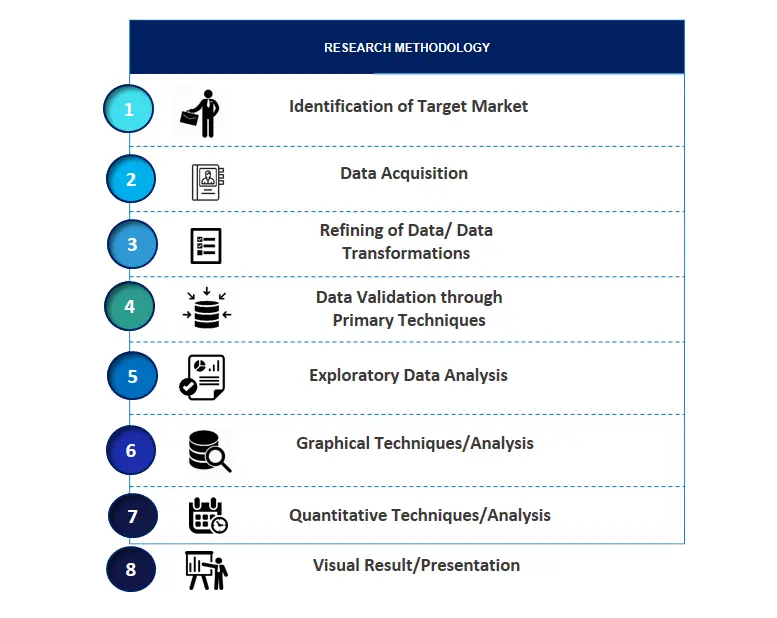
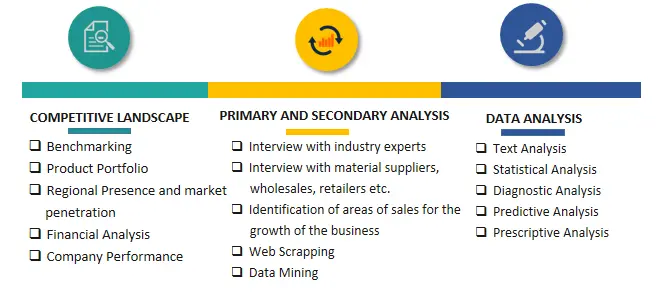
SPER Market Research’s methodology uses great emphasis on primary research to ensure that the market intelligence insights are up to date, reliable and accurate. Primary interviews are done with players involved in each phase of a supply chain to analyze the market forecasting. The secondary research method is used to help you fully understand how the future markets and the spending patterns look likes.

The report is based on in-depth qualitative and quantitative analysis of the Product Market. The quantitative analysis involves the application of various projection and sampling techniques. The qualitative analysis involves primary interviews, surveys, and vendor briefings.  The data gathered as a result of these processes are validated through experts opinion. Our research methodology entails an ideal mixture of primary and secondary initiatives.
SPER-Methodology-1

SPER-Methodology-2

SPER-Methodology-3


Frequently Asked Questions About This Report
The market is expanding due to rapid urbanization, increasing traffic congestion, and rising demand for eco-friendly and cost-effective transportation. Government initiatives promoting electric mobility and rising fuel prices are further accelerating adoption across major Asia Pacific economies.
Improved battery performance, smart connectivity, and enhanced e-bike designs are making commuting more efficient and convenient. These innovations increase range, safety, and user experience, encouraging both urban commuters and recreational riders to switch to e-bikes.
E-bikes reduce carbon emissions, lower commuting costs, and improve mobility in densely populated cities. As governments and consumers prioritize sustainability, e-bikes are becoming an essential solution for clean, low-emission urban transportation.
PLACE AN ORDER
  • 15 % off
     
    $ 4250
  • 20 % off
             
    $ 5650
  • 25 % off
         
    $ 7450
Pre-Purchase Inquiry
SEND AN INQUIRY
NEED CUSTOMIZATION?
Request Customization
CALL OR EMAIL US
US:
India:
Email:
100% Secure Payment

SPER American Express
SPER VISA
SPER Master Card
SPER Mestro
SPER Paypal
SPER CCAvenues

Have a glance of the Report

  Download Free Sample

Looking for Customization?

 Customization Request

Have a Question?

 Reach Our Analysis Team

COVID-19 impact analysis?

 Request Analysis
Thought Leadership

Trusted by Industry Leaders

Our data-driven insights have influenced the strategy of 200+ reputed companies across the globe.

SPER-Astellas Pharma
SPER-Microsoft
SPER-EY
SPER-McKinsey
SPER-Bain
SPER-Max-Healthcare
SPER-DHL
SPER-IQVIA
SPER-Mitsubishi Logistics
SPER-PACCOR
SPER-Macmillan Education
SPER-Kankar IMRB
SPER-ITA
SPER-PWC
SPER-SAPTCA
SPER-Straumann
SPER-Danaher
SPER-AandM
SPER-MENARINI Silicon Biosystems
SPER-IPSOS
SPER-Heineken
HIPPA Compliant
GDPR Certified
ISO 27001
Peer Reviewed
Get Started Today

Your Competitive Advantage in
Pharmaceutical & Medical Technology
Markets

Join industry leaders leveraging AI-powered intelligence to make confident, data-driven decisions that accelerate breakthrough treatments and technologies to market.

No Credit Card Required
15-Minute Demo
Expert Guidance